whispers in the corridors



Rajasthan’s governance transformation will be a strong pillar of Viksit Rajasthan@ 2047: Chief Secretary (UPDATED)
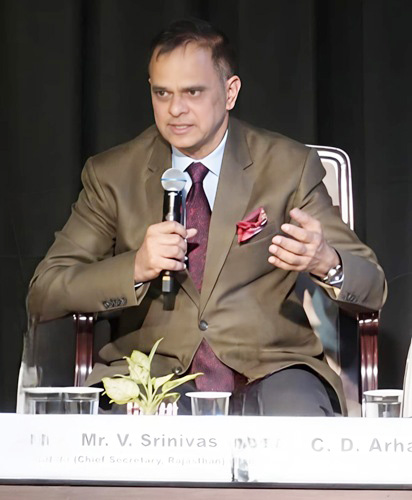
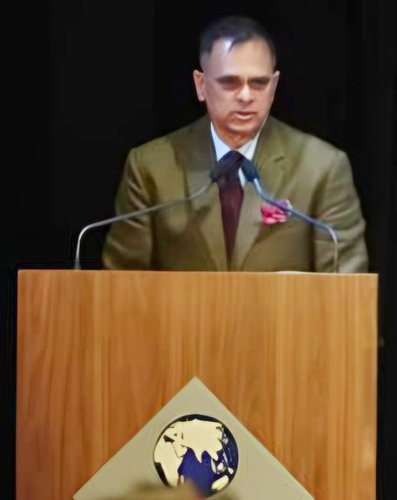 Addressing a talk on “Viksit Rajasthan @ 2047: Governance Transformed” at the Rajasthan International Centre, Chief Secretary V. Srinivas said Rajasthan is uniquely positioned to play a defining role in India’s journey towards Viksit Bharat @ 2047, drawing strength from its natural resources, clean energy potential, tourism, agriculture and strategic location. He said the State’s development pathway is anchored in inclusion, equity, sustainability and good governance, aligned with the national vision of building a developed, prosperous, equitable and future-ready India by 2047, with the Amrit Kaal (2022–2047) serving as the transformative phase for achieving that goal.
In alignment with the Prime Minister’s vision for Viksit Bharat @ 2047, the Chief Secretary said the next 25 years call for an ambitious, results-oriented good governance agenda focused on empowering citizens, ensuring last-mile delivery, and implementing initiatives aligned with the Panch Pran. The Chief Secretary added that the guiding framework of this transformation places special emphasis on GYAN — Garib, Yuva, Annadata and Nari Shakti — and that Rajasthan’s reform agenda is designed to deliver measurable outcomes for these four pillars through inclusive development, stronger service delivery and wider access to opportunity.
Referring to the vision of Viksit Rajasthan @ 2047, the CS said the State vision launched in October 2025 is not merely aspirational, but a practical roadmap to transform Rajasthan into a thriving state and a model of inclusive development by 2047. Recalling the Hon’ble Chief Minister’s statement at the time of the launch, he said the vision document reflects a clear commitment to building a prosperous, inclusive and future-ready Rajasthan. He said the roadmap rests on a four-pronged approach: nurturing people, strengthening society, building infrastructure and sustainability, and advancing policy, finance and governance reforms. It prioritises 100% literacy and education coverage, skill-based learning, healthcare access for all, sustainable water management, smart urbanisation, environmental conservation, and stronger opportunities for youth and women.
The CS said Rajasthan aims to become a $350 billion economy by 2028–29 and a $4.3 trillion economy by 2047, driven by agriculture and agri-innovation, industrial development, tourism, green energy, infrastructure and digital governance. He said the State’s strategy focuses not only on faster growth, but also on improving quality of life through better civic amenities, stronger connectivity, social security and responsive administration. Highlighting governance transformation, he said Rajasthan is moving towards citizen-centric, transparent and technology-enabled administration through reforms such as Raj-UNNATI, AI-enabled service delivery, digitized land records, project monitoring and grievance redressal. He noted that Raj-UNNATI, launched in January 2026 and modelled on the Union Government’s PRAGATI platform, has made Rajasthan the first State in India to operationalise a PRAGATI-replicated system, marking a shift from monitoring to measurable outcomes.
He added that the State’s reform momentum is also evident in ease of doing business and deregulation. Rajasthan implemented over 350 BRAP reforms in 2024, was recognized as a Top Achiever in four business reform areas and completed all 23 priority areas under Deregulation Phase-I, placing it among the top five States in the country. The State is now advancing Phase-II reforms, while also decriminalizing and rationalizing offences under 11 State Acts through the Rajasthan Jan Vishwas Ordinance 2025 to reduce compliance burden and promote an investor-friendly ecosystem.
Referring to the State’s strong implementation capacity, he highlighted that Rising Rajasthan 2024, under which Rs 35 lakh crore worth of MoUs were signed and projects worth ₹8.15 lakh crore have already been grounded, reflecting rapid on-ground implementation.
He said the road ahead will be shaped by strong infrastructure, industrial growth, and Rajasthan’s strengths in solar energy, tourism and connectivity, reinforcing the proposition that a Viksit Rajasthan is key to Viksit Bharat @ 2047.
Send Feedback
More Bureaucracy News
- NLC CMD Prasanna Kumar Motupalli conferred “Pride of Telangana” Award (UPDATED)
- Ankit Baralk posted as Assistant Controller of Accounts, CBDT (UPDATED)
- Ravi Shankar appointed as Ambassador to Greece (UPDATED)
- Interviews for CMD, India Optel Ltd on Apr 22 instead of Apr 21 (UPDATED)
- Major reshuffle of IAS officers in UP (UPDATED)
- 15 IAS officers in UP get field posting as DM
- Additional installment of DA to Central employees & DR to pensioners approved
- External Affairs Associate for Brussels, Belgium sought
- CWMA seeks applications for Dy Director (Agri) post
- Interviews to Sr Adviser post in DST on May 2
- MoEF&CC seeks Scientific Consultant, (Fin-Eco)
- DFCCIL seeks AGM/JGM/DGM-Finance for Corporate office
- R K Agrawal empanelled for appointment as IEM
- R K Verma empanelled for appointment as IEM
- Y Tripathi & R K Ghose empanelled for appointment as IEMs
- M Akhaya empanelled for appointment as IEM
- Four IFS officers of AGMUT cadre shifted to different segments
- K R Sharma made Secretary to Lt. Governor, Delhi
- Dinesh Trivedi as High Commissioner to Bangladesh, Signals New Political Priorities !
- 15 names forwarded for elevation as Judges, Delhi High Court
- Ms Karamjeet Kaur returns to parent cadre
- ECI shifts Avinash Kumar as IG, Intelligence, Tamil Nadu
- Tenure of Satyajit Mohanty as Joint Secretary, Defence extended
- Upgraded posting of Ms Himani Pande to Additional Secretary level extended
- Interviews for Director (Tech), ECL on Apr 22
- Canara Bank is being run by acting CMD ?
- Ajit Kumar Panda selected for CMD, CONCOR
- Jitendra Kumar is unlikely to get extension as MD, BIRAC
- ECI seizes over Rs 865 crore in TN and West Bengal ahead of assembly polls
- Cadre of Pallavi Mishra transferred to Punjab
- Tenure of Ms Soma Mondal as Member, PESB ending in Apr
- Dr K S Somashekhar is new Secretary, Rajya Sabha
- Sanjay Lohiya to be Secretary Financial Services
- Navy Chief to retire in May
- IAS Mohammad Aaquib Drives School Education, SHG Livelihood Push in Border District Champhai, Mizoram